

- Home
- Granite Bay
Outdoor construction in Granite Bay.
Granite Bay lots are large enough that the design question stops being what to put in the yard and becomes how the whole property should be organised.
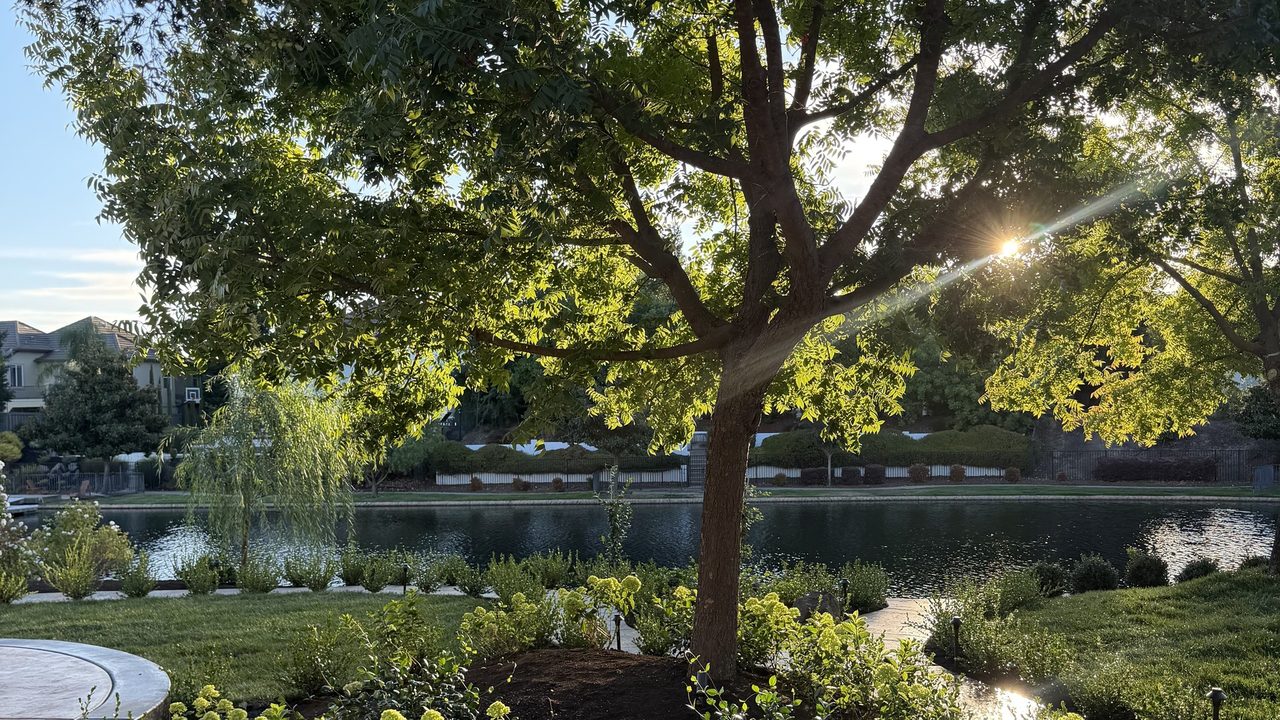
What a Granite Bay build has to deal with.
Every area we work in has its own version of the same problem. This is ours here.
Acreage changes the brief.
On a half-acre or more you are not decorating a rectangle, you are laying out zones and the routes between them. Where the drive arrives, where the entertaining space sits relative to the house, what stays as open ground, and how you get from one to another without walking across a lawn in the dark.
The oaks are the design, not an obstacle.
Mature valley and live oaks are the reason people buy here. They also have root zones that do not tolerate trenching, grade changes or irrigation against the trunk. We plan hardscape and utility runs around the critical root zone rather than through it.
Long runs need real infrastructure.
Big properties mean long irrigation mains, low-voltage runs that actually drop voltage, and drainage with somewhere to go. Sizing that properly at the start is cheaper than discovering it in year two.
Unincorporated, which changes who you are dealing with.
Granite Bay is not a city. It is unincorporated Placer County, so there is no local building department — permits, inspections and any grading review go through the county, and the standards applied are the county's rather than a municipal set. That is worth knowing before planning anything, because it also means the plan-check counter is not five minutes away, and because county requirements for grading and drainage on larger parcels are not the same as the ones a tract lot in a city gets waved through under.
Lots here are also bigger, frequently well over the quarter-acre that most of the valley is subdivided into, and a larger parcel changes the drainage conversation from “where does this patio shed” to “where does the whole property shed, and onto whom”. Discharging concentrated runoff onto a neighbour is a problem at any size and a much more visible one when the volumes are larger.
Heritage oaks, and why the drip line decides the design.
The oak woodland is the reason people live here and the constraint most projects have to design around. Native valley and blue oaks evolved for wet winters and a bone-dry summer, and their roots run far wider than the canopy suggests — well beyond the drip line, mostly in the top few feet of soil where any excavation happens.
Three things kill them, and all three are construction. Compaction from machinery over the root plate. Raised grade or fill placed over the roots, which suffocates them. And summer irrigation: warm wet soil at the root crown is precisely the condition root-rot pathogens want, and an old oak has no defence against a season it never evolved to meet. A lawn or a new planting bed installed under an oak canopy is one of the most reliable ways to lose the tree, and the decline shows up a season or two later, long after anyone connects the two.
So on an oak lot the sequence inverts: the tree's root zone is drawn first and the design fits around it. Paving that must cross a root zone can often be built on grade rather than by excavating, and irrigation is kept out of the canopy entirely. Placer County also regulates native oak removal, so a tree that looks like a design obstacle may be a permit question before it is a design one — and assessing or removing one is a certified arborist's work, not a landscaper's.
Who signs it off.
Granite Bay is unincorporated, so permits go through Placer County rather than a city. Some properties have septic systems and defensible-space considerations that affect where structures can sit; we work that out before the design is finished.
Granite Bay sits in Placer County. We pull the permits and meet the inspector on site.
What we build in Granite Bay.
From one patio to a whole property. There is no minimum job.
- Full backyard builds
- Front yards & curb appeal
- Side yard conversion
- Retaining walls & terracing
- Concrete, pavers & masonry
- Drainage & grading
- Pool decks & spa surrounds
- Covered patios & pergolas
- Irrigation & low-voltage lighting
- Turf, sod & planting
- Commercial & multi-family grounds
Granite Bay, specifically.
Yes. We plan around the critical root zone, keep hardscape and trenching out of it, and where a permit requires an arborist we bring one in.
That is most of what we do in Granite Bay — front, back, sides and drive as one sequenced build rather than four separate jobs.
Roseville Rocklin Folsom El Dorado Hills Lincoln Loomis Citrus Heights
Book the site walk.
On the ground in Granite Bay, no charge, and you will know what the job actually costs.